
Concrete Block Wall Construction in North Tonawanda, NY
North Tonawanda Concrete Services designs and builds concrete block walls for homeowners throughout North Tonawanda and the wider Western New York area. Whether you need a retaining wall, a privacy wall, or a structural block wall for any application, we build it right the first time.
25+
Years of Experience
400+
Jobs Done
4.9/5
Average Customer Rating
What Concrete Block Walls Are Used For and Why They Work So Well
Concrete block walls are one of the most versatile and durable structural solutions available to residential property owners. They serve a wide range of purposes depending on where they are installed and how they are designed, from retaining sloped ground and preventing erosion to creating privacy boundaries, defining outdoor spaces, supporting structures, and providing wind or noise barriers in exposed or busy locations.
The material itself is exceptionally well suited to the demands of a Western New York climate. Concrete masonry units, commonly known as CMU or concrete block, are dense, moisture-resistant, and dimensionally stable through the freeze-thaw cycles that characterize upstate winters. When properly laid with correct mortar, appropriate reinforcement, and the right drainage considerations built in, a concrete block wall is a permanent structure that will outlast most other fencing or boundary materials by decades with minimal maintenance required.
For homeowners in North Tonawanda who are dealing with a sloped yard that is eroding or difficult to use, a property boundary that needs a solid and permanent solution, or a structural need that requires a load-bearing masonry wall, concrete block is one of the most reliable and cost-effective materials available. The range of applications is broad, and the finished result is a structure that looks clean, performs reliably, and adds genuine value to the property.
Who Needs a Concrete Block Wall and When to Build One
Retaining walls are among the most common applications for concrete block on residential properties, and the need for them is easy to identify. Any yard where a slope is causing soil to erode, where a grade change between neighboring properties is creating drainage problems, or where a usable flat area needs to be created out of a sloped section of the yard is a strong candidate for a concrete block retaining wall. Without a properly built retaining structure, soil erosion is an ongoing problem that gets worse every year, slowly undermining landscaping, affecting drainage patterns, and reducing the usable area of the yard.
Privacy walls are another common application, particularly for homeowners who want a more permanent and substantial boundary than a wooden fence can provide. A concrete block privacy wall does not rot, warp, blow over in high winds, or require painting and staining to maintain its appearance. It provides a solid, permanent boundary that performs consistently regardless of weather conditions and requires essentially no ongoing maintenance beyond occasional cleaning.
Structural block walls for garages, outbuildings, foundation applications, and below-grade construction are also within our scope of work. These applications require careful attention to reinforcement, mortar specification, and load calculations to ensure the wall performs correctly under the structural demands placed on it. Homeowners who choose not to address a failing or absent retaining structure are accepting ongoing erosion, drainage problems, and loss of usable yard area that compounds over time. The longer the situation is left unaddressed, the more soil movement occurs and the more extensive the remediation work becomes.
Our Block Wall Construction Process, Step by Step
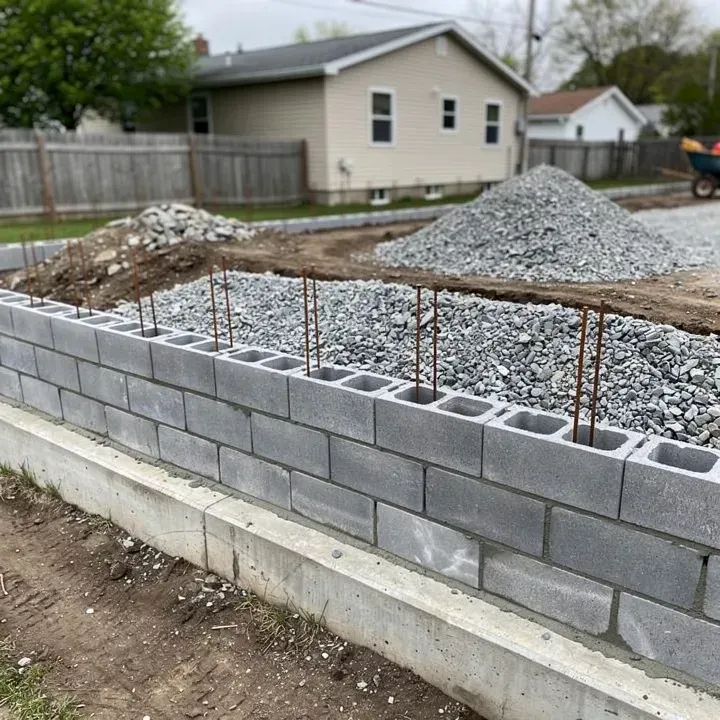
Every concrete block wall we build starts below the surface, because a wall is only as solid and stable as the footing it sits on. We begin by excavating to the appropriate depth for the footing, which needs to reach below the frost line in North Tonawanda to prevent seasonal ground movement from undermining the wall above it. The footing is formed and poured as a continuous reinforced concrete base that distributes the load of the wall evenly into the stable soil beneath it. Getting the footing right in terms of depth, width, level, and reinforcement is the single most important factor in the long-term performance of the wall.
Once the footing has cured to adequate strength, we begin laying the first course of block directly on the footing, establishing the alignment, level, and plumb of the wall from the very first course. Each subsequent course is laid with consistent mortar joints and checked continuously for level and plumb as the wall rises. For walls that require vertical reinforcement, rebar is set in the footing and runs up through the cores of the block as the wall is built, with those cores filled with grout to create a reinforced wall assembly with significantly greater structural strength than an unreinforced block wall.
For retaining walls specifically, drainage behind the wall is a critical design consideration that is built in from the start rather than added as an afterthought. Without adequate drainage, water pressure builds up behind the wall and exerts forces on the structure that it was not designed to resist, leading to cracking, displacement, and eventual failure. We install drainage aggregate and drainage pipe behind retaining walls as a standard part of the installation to ensure water is managed correctly and the wall performs as intended for its full service life.
What Determines the Cost of a Concrete Block Wall
The cost of a concrete block wall project is influenced by several factors specific to each installation. The total length and height of the wall are the primary drivers, as they determine the number of blocks required, the amount of mortar and grout, the size and length of the footing, and the overall labor involved in the installation. Taller walls require more reinforcement and more careful structural consideration than shorter walls, and this is reflected in the materials and labor cost.
The depth of the footing required for the specific site is another meaningful cost factor. In North Tonawanda, footings need to reach below the frost line, and sites where that requires deeper excavation due to grade conditions or soil characteristics add to the overall cost. The soil conditions at the site also influence the preparation work needed before the footing can be established.
For retaining walls, the amount of drainage material required behind the wall and the complexity of managing the retained soil during construction both affect the overall cost. Taller retaining walls that hold back significant amounts of soil require more robust drainage systems and more substantial reinforcement than lower walls retaining modest grade changes. Any additional features such as wall caps, decorative block faces, integrated steps, or openings in the wall for gates or access add to the material and labor cost as well. We provide a complete written estimate after assessing your specific site and project requirements so you have a clear and accurate picture of the full investment before any work begins.
Frequently Asked Questions
How tall can a concrete block retaining wall be before it needs engineering?
For residential retaining walls, walls up to four feet in height are generally within the range that an experienced contractor can design and build correctly based on established practice and local building norms. Walls above four feet in height, particularly those retaining significant amounts of soil or located near structures, driveways, or other load-bearing elements, typically require engineered drawings that specify the footing dimensions, reinforcement requirements, and drainage design precisely for the specific site conditions. In North Tonawanda, permit requirements for retaining walls above a certain height may also apply, and we confirm those requirements during the planning phase of every project. We always err on the side of building walls that are more robust than strictly necessary rather than cutting corners on reinforcement or drainage.
How long will a concrete block wall last?
A properly built concrete block wall with an adequate footing, correct reinforcement, and appropriate drainage behind it where applicable will last for many decades with minimal maintenance. Concrete masonry is inherently durable and resistant to the moisture, temperature cycling, and biological growth that causes other materials to deteriorate over time. The most common cause of premature block wall failure is inadequate drainage behind retaining walls, which allows water pressure to build up and eventually push the wall out of alignment or cause cracking at the base. We build drainage into every retaining wall installation as a standard component precisely because it is the single most important factor in the long-term performance of the wall.
Can a concrete block wall be finished or faced to improve its appearance?
Yes, and there are several options depending on the look you want to achieve. A standard gray concrete block wall with clean mortar joints has a straightforward utilitarian appearance that is perfectly suitable for many applications. If you want a more finished look, the face of the wall can be parged with a thin concrete render coat that creates a smooth or textured surface that can be painted. Decorative block with a split-face or ground-face texture is another option that provides a more architectural appearance without any additional finishing work. Coping stones or poured concrete caps along the top of the wall add a clean finished edge that also protects the top course of block from water infiltration. We discuss all available options during the estimate visit so you can choose the finish that works best for your property and budget.
Do I need a permit to build a concrete block wall on my property?
Permit requirements for concrete block walls in North Tonawanda depend on the type of wall, its height, and its location on the property. Retaining walls above a certain height, typically around four feet, generally require a permit from the City of North Tonawanda's Building Department. Privacy or boundary walls may also require permits depending on their height and proximity to property lines. We are familiar with local permitting requirements and will advise you on whether a permit is needed for your specific project before work begins. When a permit is required, we assist with the process and ensure the work is carried out to the standards required for inspection and approval.
Let's Talk About Your Concrete Project!
Whether you are dealing with a cracked driveway that has been bothering you for years, planning a new patio for the backyard, or facing a foundation issue that needs professional attention, North Tonawanda Concrete Services is ready to help. We offer free on-site estimates with no obligation, clear and honest pricing, and the kind of quality workmanship that comes from 25 years of doing this work right here in Western New York.
Do not wait for a small problem to turn into an expensive one. Give us a call or send us a message today and we will set up a time to come out, take a look at your project, and give you a written estimate you can count on. We are local, we are experienced, and we are ready to get to work for you.

Contact
(716) 403-4926
Mon–Sun: 7am–7pm
North Tonawanda, NY
About Us
North Tonawanda Concrete Services is a locally owned concrete contracting business with over 25 years of experience serving homeowners throughout North Tonawanda and the wider Western New York region. We handle residential concrete projects of all sizes, from smaller repairs and improvements to full installations and new construction work. Our service area covers North Tonawanda and the surrounding communities across Niagara and Erie County. If you have a concrete project that needs to be done right, we would love to hear from you.
© Copyright 2026 North Tonawanda Concrete Services. All rights reserved.
© Copyright 2026 North Tonawanda Concrete Services.
All rights reserved.