
Concrete Sidewalk Installation in North Tonawanda, NY
North Tonawanda Concrete Services installs and replaces concrete sidewalks for homeowners throughout North Tonawanda and the wider Western New York area. We pour clean, properly graded walkways that improve safety, curb appeal, and the overall look of your property.
25+
Years of Experience
400+
Jobs Done
4.9/5
Average Customer Rating
What a New Concrete Sidewalk Does for Your Property
A concrete sidewalk does more for a property than simply providing a path from one point to another. It defines the approach to your home, contributes significantly to curb appeal, and plays a direct role in the safety of everyone who walks on your property. A clean, level sidewalk makes a strong first impression and signals that a home is well cared for. A cracked, uneven, or deteriorating one does the opposite, and it introduces a genuine safety hazard that affects family members, visitors, and anyone else who uses it.
For homeowners in North Tonawanda, the demands placed on a concrete sidewalk are considerable. Upstate winters bring repeated freeze-thaw cycles, heavy snowfall, ice, and the use of deicing materials that take a toll on concrete surfaces over time. A sidewalk that was not installed correctly to begin with will show the effects of those conditions far sooner than one that was built with the right materials, the right base preparation, and the right finishing technique.
Beyond safety and appearance, a properly installed concrete sidewalk also manages water correctly. When sidewalk panels settle unevenly or crack and shift, water pools on the surface and can drain in directions it was never meant to go. A new sidewalk, correctly graded from the start, keeps water moving away from your home and off the walking surface where it belongs.
Is Your Sidewalk Past the Point of Patching?
The most obvious indicator that a sidewalk needs replacing is visible damage: cracks running across or along panels, sections that have risen or dropped relative to adjacent panels, crumbling edges, and surface scaling that has progressed past isolated spots to cover significant areas of the walkway. Any of these conditions on their own are worth addressing. When several of them are present across the same sidewalk, patching individual sections rarely makes sense from a cost or longevity standpoint.
Uneven panels are a particular concern because the lips and raised edges they create between sections are among the most common causes of trip-and-fall accidents on residential properties. This is especially true in winter, when snow and ice can conceal an uneven edge entirely until someone catches their foot on it. For homeowners with young children or older family members who use the sidewalk regularly, an uneven surface is a hazard that warrants prompt attention rather than ongoing monitoring.
There is also a practical financial consideration. Continuing to patch a sidewalk that is deteriorating across multiple panels delays the inevitable while adding incremental costs that add up over time. A full replacement addresses the entire surface at once, restores proper drainage and level, and gives you a sidewalk that will not need attention again for decades when it is installed correctly the first time.
How We Build a Sidewalk That Stays Level and Lasts for Decades
Every sidewalk installation we carry out starts with the complete removal of the existing surface where one is present. We break up the old concrete panels, load them out, and haul them away so the base beneath can be properly inspected and prepared. Skipping this assessment and simply pouring over an existing compromised base is one of the most common reasons replacement sidewalks fail prematurely, and it is something we never do.
With the old surface removed, we excavate to the appropriate depth and compact the sub-base thoroughly. Where soil conditions call for it, we add and compact a gravel layer to improve drainage and create a stable, uniform foundation that will not shift or settle unevenly under the new concrete. The quality of this base preparation directly determines how well the finished sidewalk holds up over the years ahead.
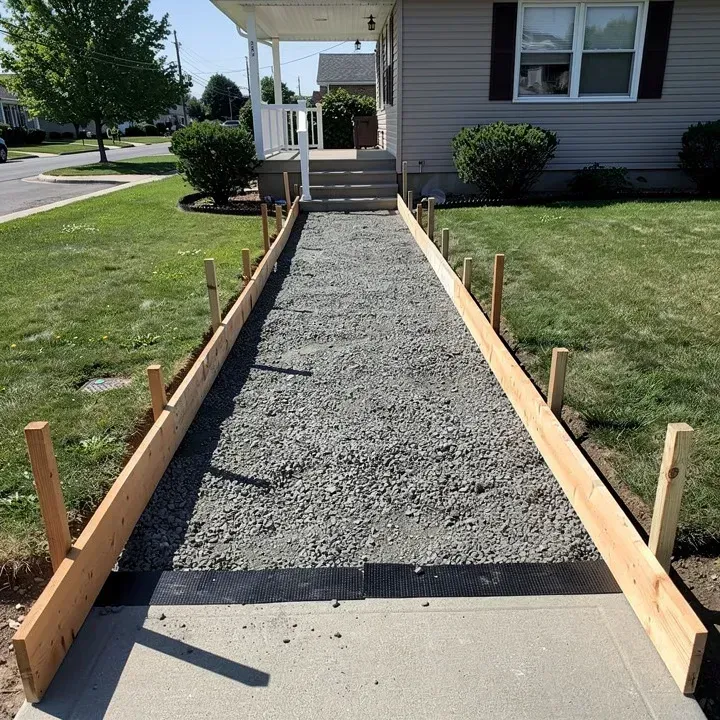
We then set the forms to define the width, alignment, and elevation of the new sidewalk, carefully establishing the correct slope so the surface sheds water away from the house and off the walking surface efficiently. Expansion joint material is placed between the new sidewalk and any adjacent structures such as steps, stoops, or driveways to allow for independent movement and prevent stress cracking at those connection points. We pour the concrete, finish it with a broom texture for safe traction in wet and icy conditions, and cut control joints at regular intervals to manage where any future movement in the slab occurs. The surface is then allowed to cure fully before it is put back into regular use.
Why Sidewalk Replacement Costs Vary From One Property to the Next
The cost of a concrete sidewalk installation is driven by a combination of factors specific to each property and project. The total linear footage and width of the sidewalk are the primary considerations, as they determine the overall square footage of concrete to be poured and the amount of forming, finishing, and base preparation work involved.
The condition of the existing surface and what is beneath it plays a significant role as well. A sidewalk that sits on a well-compacted, stable base requires less preparation work than one where the sub-base has eroded, shifted, or been disturbed by tree roots over the years. In cases where roots have caused significant heaving or base disruption, addressing the root situation before pouring new concrete may also be necessary to prevent the same problem from recurring.
Site-specific factors such as slope, proximity to landscaping, steps, or other structures, and the accessibility of the work area can also affect the labor involved. Any additions to the project such as a front entry walkway, a path connecting to a side entrance, or steps up to a stoop or porch can be incorporated into the same project and are always more cost-effective to include at the time of the original installation than to add separately later. We provide a detailed written estimate after reviewing your specific property so you have a complete and accurate picture of the investment before any work begins.
Frequently Asked Questions
How wide should a residential concrete sidewalk be?
The standard width for a residential sidewalk is between three and four feet, which provides comfortable passage for a single person and allows two people to walk side by side without difficulty. Front entry walkways that connect a driveway or public sidewalk to the front door are often done at four feet to create a more welcoming approach. If you have specific requirements such as wheelchair accessibility or a wider path to accommodate outdoor furniture or equipment movement, we can accommodate any width that works for your property. We discuss the appropriate dimensions during the estimate visit based on how the sidewalk will be used and how it connects to the rest of the property.
Will the new sidewalk match the rest of my property?
A standard concrete sidewalk in light gray is the most common finish and blends naturally with most residential properties. If you want something that stands out or ties in more deliberately with other elements of the property, we can discuss options such as a broomed texture with a defined border, exposed aggregate, or even a stamped finish that adds pattern and color to the walking surface. Any decorative options are discussed and priced during the estimate so you can weigh the visual benefit against the additional cost and make the choice that is right for you.
How do I keep my new concrete sidewalk in good condition long term?
The most important thing you can do is apply a quality concrete sealer within the first year after installation and reseal every two to three years thereafter. Sealing protects the surface from moisture infiltration and the damaging effects of road salt and deicing chemicals, which are unavoidable realities of sidewalk maintenance in Western New York. During the first winter after installation, use sand rather than chemical deicers for traction on the new surface, as fresh concrete is more vulnerable to surface scaling from salt exposure than fully cured concrete. Keep the surface clear of standing water where possible, and address any small cracks that develop early before they have the chance to widen through freeze-thaw cycles. A properly sealed and maintained concrete sidewalk should give you decades of reliable, low-maintenance service.
Can you replace just one or two damaged panels instead of the whole sidewalk?
In some cases, yes. If the damage is genuinely isolated to one or two panels and the rest of the sidewalk is in solid condition with a good base beneath it, replacing individual sections can be a practical and cost-effective approach. However, if the surrounding panels show signs of cracking, settling, or base deterioration, partial replacement often ends up being false economy. The new panels may not match the existing surface perfectly, and the underlying issues that caused the damage in the first place are likely to affect the adjacent sections before too long. We assess the full condition of the sidewalk during the estimate visit and give you an honest recommendation about whether partial or full replacement makes more sense for your specific situation.
Let's Talk About Your Concrete Project!
Whether you are dealing with a cracked driveway that has been bothering you for years, planning a new patio for the backyard, or facing a foundation issue that needs professional attention, North Tonawanda Concrete Services is ready to help. We offer free on-site estimates with no obligation, clear and honest pricing, and the kind of quality workmanship that comes from 25 years of doing this work right here in Western New York.
Do not wait for a small problem to turn into an expensive one. Give us a call or send us a message today and we will set up a time to come out, take a look at your project, and give you a written estimate you can count on. We are local, we are experienced, and we are ready to get to work for you.

Contact
(716) 403-4926
Mon–Sun: 7am–7pm
North Tonawanda, NY
About Us
North Tonawanda Concrete Services is a locally owned concrete contracting business with over 25 years of experience serving homeowners throughout North Tonawanda and the wider Western New York region. We handle residential concrete projects of all sizes, from smaller repairs and improvements to full installations and new construction work. Our service area covers North Tonawanda and the surrounding communities across Niagara and Erie County. If you have a concrete project that needs to be done right, we would love to hear from you.
© Copyright 2026 North Tonawanda Concrete Services. All rights reserved.
© Copyright 2026 North Tonawanda Concrete Services.
All rights reserved.