
Concrete Foundation Services in North Tonawanda, NY
North Tonawanda Concrete Services provides expert concrete foundation work for homeowners and builders throughout North Tonawanda and the wider Western New York area. From new foundation pours to repairs and stabilization of existing structures, we handle every aspect of the work with the precision and care it demands.
25+
Years of Experience
400+
Jobs Done
4.9/5
Average Customer Rating
What Your Foundation Does and Why It Has to Be Right
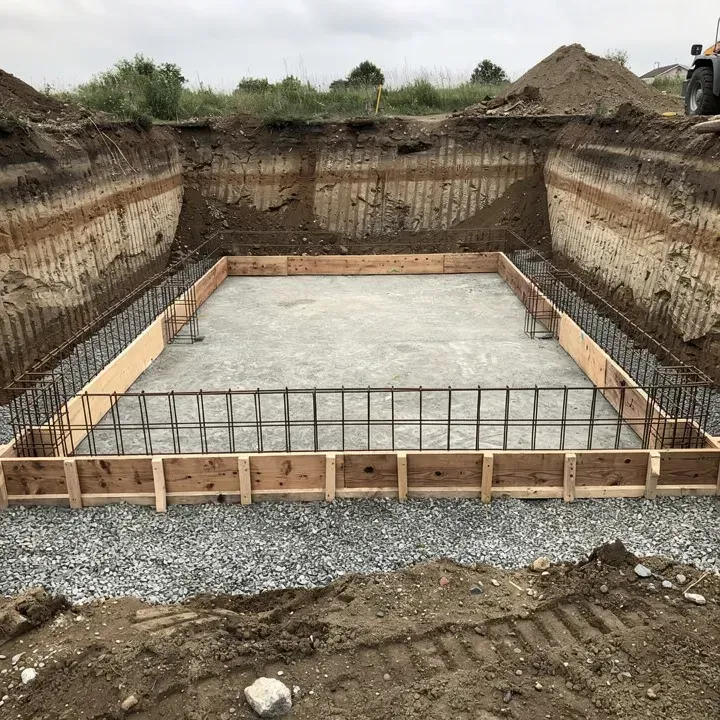
Every structural element of your home, from the framing and walls to the roof and everything inside, ultimately rests on the foundation. It is the single most critical concrete installation a home will ever have, and the consequences of getting it wrong are more far-reaching and more expensive to correct than any other type of concrete work. A well-built foundation transfers the full load of the structure above it safely into the ground, resists the lateral pressure of the surrounding soil, manages water and moisture at the lowest point of the home, and remains stable through decades of seasonal ground movement and freeze-thaw cycles.
In Western New York, foundations face a particularly demanding set of conditions. The freeze-thaw cycles that characterize upstate winters exert significant pressure on foundation walls and footings year after year. Soil conditions across the North Tonawanda area vary considerably from one property to the next, and understanding those conditions before designing and pouring a foundation is essential to ensuring the finished structure performs as intended. A foundation that was built without proper consideration of local soil conditions, frost depth, and drainage is a foundation that will begin showing problems long before it should.
The investment in a properly designed and executed foundation is not something that can be undone and redone easily once the structure above it is in place. Getting it right the first time is not just the best approach. For practical purposes, it is the only approach that makes sense.
Who Needs Foundation Work and When to Address It
Foundation work falls into two broad categories: new construction and repair or stabilization of existing foundations. New construction applications include foundations for new homes, additions to existing homes, detached garages, accessory structures, and any other project where a permanent concrete base needs to be established from the ground up. In every one of these cases, the foundation needs to be designed and poured correctly from the start, because correcting foundation problems after the structure above is built is extraordinarily difficult and expensive.
Existing foundation repair is needed when homeowners observe signs that the foundation is no longer performing as it should. The warning signs are worth knowing and taking seriously. Vertical cracks in poured concrete foundation walls are common and often the result of normal concrete shrinkage, but they still need to be evaluated and sealed to prevent water infiltration. Horizontal cracks in foundation walls are a more serious indication of lateral soil pressure and warrant immediate professional assessment. Stair-step cracking in concrete block foundations indicates differential settlement and is a sign that the foundation is moving in ways it should not be.
Water staining, efflorescence, or active moisture on interior foundation walls indicates that water is finding its way through the concrete, which leads to ongoing moisture problems in the basement and accelerates the deterioration of the wall itself. Bowing or visible deflection in a foundation wall is among the most serious conditions a homeowner can encounter and requires prompt professional attention before the situation progresses further. Any of these signs observed on your property is a reason to have the foundation assessed by an experienced concrete contractor sooner rather than later.
Our Foundation Installation and Repair Process, Step by Step
Every foundation project we take on begins with a thorough assessment of the site or the existing structure, depending on whether the work involves new construction or repair. For new foundations, this means evaluating soil conditions, establishing the correct frost depth for the footings, confirming the design loads the foundation needs to support, and planning the drainage strategy around the perimeter of the foundation before any excavation begins. A foundation that is designed with all of these factors properly accounted for is a foundation that will perform reliably for the lifetime of the structure above it.
Excavation is carried out to the required depth, which in North Tonawanda and the surrounding Western New York area means getting below the frost line to ensure footings are established in stable, undisturbed soil that will not move with seasonal freezing and thawing. Footings are formed and poured first, providing the base on which the foundation walls will sit. The footing dimensions are determined by the load they need to carry and the bearing capacity of the soil beneath them.
Foundation walls are then formed using steel forms that produce clean, accurately dimensioned concrete walls with the strength and density required for the application. Reinforcement is placed within the wall forms before the concrete is poured to give the walls the tensile and flexural strength needed to resist soil pressure and any other lateral forces they will encounter. After the concrete is poured and has reached adequate strength, the forms are stripped, and the walls are inspected before waterproofing and drainage measures are applied to the exterior face of the foundation. Proper waterproofing and perimeter drainage are not optional finishing touches. They are essential components of a foundation system that manages water correctly and protects the structure for decades.
For repair work, the process begins with a careful assessment of the type, location, and extent of the damage before any remediation work begins. Different types of foundation problems require different solutions, and applying the wrong fix to a foundation problem can mask the symptom while leaving the underlying cause unaddressed. We diagnose accurately before we recommend any course of action, and we explain our findings and recommendations in plain language so homeowners fully understand what is being done and why.
Understanding the Factors Behind Foundation Project Pricing
Foundation work encompasses a wider range of project types and complexity levels than almost any other category of concrete work, and the cost variation between projects reflects that range accurately. For new foundation installations, the primary cost drivers are the overall footprint of the foundation, the depth required to get below the frost line, the wall height above grade, and the specific design requirements of the structure being supported. Larger footprints, deeper excavations, and taller walls all increase the amount of forming, concrete, reinforcement, and labor involved.
Soil conditions at the specific site also have a meaningful impact on cost. Sites with stable, well-draining soil are more straightforward to work with than sites with expansive clay soils, high water tables, or significant rock that complicates excavation. In some cases, additional drainage measures such as perimeter drain tile systems or sump pit installations need to be incorporated into the foundation design to manage groundwater effectively, and these add to the overall project cost while being essential to the long-term performance of the foundation.
For repair work, the cost depends on the type of problem being addressed, the extent of the damage, and the method required to correct it effectively. Minor crack sealing and waterproofing treatments are at the lower end of the cost range. More significant structural repairs involving wall stabilization, underpinning, or section replacement are considerably more involved and priced accordingly. In every case, we provide a detailed written assessment and estimate after inspecting the foundation so you have a clear and accurate picture of what the work involves and what it will cost before any decisions are made.
Frequently Asked Questions
How deep do footings need to be in North Tonawanda?
In North Tonawanda and the surrounding Western New York area, footings need to be established below the frost line to prevent movement caused by seasonal freezing and thawing of the soil above them. The frost depth in this part of New York State is typically around 48 inches, meaning footings need to be at least four feet below finished grade to be considered adequately protected from frost heave. The exact depth required for a specific project may be influenced by local soil conditions, the bearing capacity of the soil at the site, and the requirements of the local building department. We confirm the appropriate footing depth for every project during the planning phase and ensure the work meets all applicable local requirements.
What is the difference between a poured concrete foundation and a concrete block foundation?
A poured concrete foundation is formed using steel or aluminum forms into which concrete is poured as a single continuous wall, producing a monolithic structure with no joints or seams in the wall itself. Poured concrete walls are generally stronger in resisting lateral soil pressure, easier to waterproof effectively, and less prone to water infiltration than block walls because there are no mortar joints for water to work through.
A concrete block foundation, also known as a concrete masonry unit or CMU foundation, is constructed by laying individual concrete blocks in courses with mortar joints between them. Block foundations have been used successfully for many decades and remain a practical option in certain applications, particularly for additions and accessory structures. Each approach has its appropriate applications, and we discuss the options that make most sense for your specific project during the assessment and planning phase.
How do I know if my foundation crack is serious?
Not all foundation cracks are equally serious, but none of them should be ignored without at least having them assessed by an experienced contractor. Hairline vertical cracks that appear shortly after a poured foundation has cured are often the result of normal concrete shrinkage and may only require sealing to prevent water infiltration. Wider vertical cracks, cracks with noticeable displacement between the two sides, and any crack that appears to be actively growing are more serious and warrant prompt evaluation.
Horizontal cracks in foundation walls are the most concerning type and indicate that the wall is experiencing lateral pressure from the surrounding soil that is exceeding its design capacity. This type of crack should be assessed immediately, as a wall under that kind of stress can progress to the point of structural failure if left unaddressed. Stair-step cracks in block foundations and any cracking accompanied by visible bowing or deflection of the wall also require prompt professional attention. When in doubt, have it looked at. The cost of an assessment is negligible compared to the cost of addressing a foundation problem that has been allowed to progress.
Do you handle waterproofing as part of the foundation work?
Yes, exterior waterproofing and drainage measures are incorporated into our foundation installations as a standard part of the work rather than as an afterthought. A foundation wall that has been properly waterproofed on the exterior face and is protected by a functioning perimeter drainage system manages groundwater correctly and remains dry on the interior over the long term. We apply waterproofing membrane to the exterior face of the foundation walls before backfilling and ensure that perimeter drainage is correctly established to carry water away from the foundation rather than allowing it to build up against the wall.
For existing foundations where water infiltration is occurring, we assess the source and pathway of the moisture before recommending a remediation approach. In some cases, exterior excavation and waterproofing is the most effective long-term solution. In others, interior drainage systems combined with crack sealing can manage the issue effectively. We give you an honest assessment of the options and their relative effectiveness for your specific situation so you can make an informed decision.
Let's Talk About Your Concrete Project!
Whether you are dealing with a cracked driveway that has been bothering you for years, planning a new patio for the backyard, or facing a foundation issue that needs professional attention, North Tonawanda Concrete Services is ready to help. We offer free on-site estimates with no obligation, clear and honest pricing, and the kind of quality workmanship that comes from 25 years of doing this work right here in Western New York.
Do not wait for a small problem to turn into an expensive one. Give us a call or send us a message today and we will set up a time to come out, take a look at your project, and give you a written estimate you can count on. We are local, we are experienced, and we are ready to get to work for you.

Contact
(716) 403-4926
Mon–Sun: 7am–7pm
North Tonawanda, NY
About Us
North Tonawanda Concrete Services is a locally owned concrete contracting business with over 25 years of experience serving homeowners throughout North Tonawanda and the wider Western New York region. We handle residential concrete projects of all sizes, from smaller repairs and improvements to full installations and new construction work. Our service area covers North Tonawanda and the surrounding communities across Niagara and Erie County. If you have a concrete project that needs to be done right, we would love to hear from you.
© Copyright 2026 North Tonawanda Concrete Services. All rights reserved.
© Copyright 2026 North Tonawanda Concrete Services.
All rights reserved.